Many purchasers only test performance with a heat gun to check shrinkage. What they often overlook is that the quality of FEP heat shrink tubing is largely determined before expansion and setting.
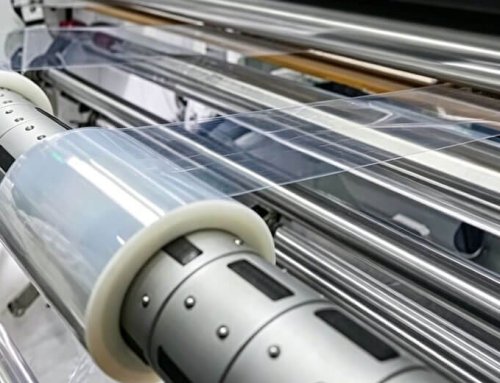
FEP heat shrink tubing is not extruded directly to its final expanded dimension. We first extrude a low crystallinity, high toughness FEP base tube. It is then radially expanded using clean compressed air and rapidly cooled, locking tensile stress inside the material. Upon reheating, the tubing starts to shrink at 130‑150 °C. For full and complete recovery, MTK FEP‑HST requires temperatures above 200 °C, so the material can spring back to its original base tube dimension.
Take a real‑world case from one of our medical‑device partners: the customer required heat shrink tubing with an expanded inner diameter of 1.78 mm, designed to recover fully over a 1 mm component. Instead of extruding the base tube to exactly 1 mm ID, we produce the base tube at 0.9 mm inner diameter. It is intentionally slightly smaller than the target recovered size to create an interference fit and ensure tight clamping over the part after shrinkage. This 0.9 mm base tube is then expanded to the finished expanded ID of 1.78 mm for supply. The two step principle sounds straightforward. However, trade‑offs in process parameters are what separate good‑performing products from poor ones across different manufacturers.
Base tube extrusion is the critical first checkpoint. We run extrusion at low temperature and low speed, tightly controlling key parameters: in‑line draw ratio 3‑7, melt‑cone length 10‑20 mm, die compression ratio 1.4‑3. Our main production wall thickness range is 0.25‑0.40 mm with a tolerance of ±0.02 mm. Fast quenching suppresses crystallinity and preserves sufficient ductility for subsequent expansion. Any impurities or wall thickness variations in the base tube will be magnified during expansion and shrink recovery.
Two expansion methods are available: continuous expansion and batch / intermittent expansion. Continuous expansion delivers high throughput and unlimited continuous lengths. Intermittent expansion yields superior roundness and concentricity and is preferred for precision medical‑grade parts. Stable expansion depends on the interaction of three variables: temperature 130‑190 °C, pressure 0.1‑0.25 MPa, and haul‑off speed. Our shop floor practical guideline: once target blow‑up ratio is achieved, keep temperature and pressure as low as feasible while maximizing haul‑off speed. This reduces residual stress in finished tubing and mitigates risk of cracking in service.
Tube rupture during expansion is rarely caused by raw material defects. It typically stems from process imbalance: uneven temperature distribution, excessive pressure, or misaligned fixturing in intermittent production.
When sourcing FEP heat shrink tubing, do not rely solely on shrink ratio specifications. Prioritize wall thickness uniformity, roundness, and batch‑to‑batch stability of blow‑up ratio. Request full data sheets for industrial orders. For medical‑grade applications, insist on supporting biocompatibility documentation. Most FEP heat shrink tubing is built to order. Confirm expanded inner diameter, recovered inner diameter and wall thickness before placing orders.
FAQ
Q1: Should I choose continuous or intermittent expansion?
A1: Choose continuous expansion if you need long continuous lengths and prioritize cost and lead time with moderate cosmetic requirements. Select intermittent expansion for precision medical components, non‑standard sizes, or tight roundness / concentricity requirements. Intermittent production runs slower at higher unit cost but delivers better consistency.
Q2: Why does some FEP heat shrink tubing crack upon heating after period of use?
A2: A frequent root cause is production running close to the upper temperature limit of 190 °C during expansion. This degrades material toughness and leaves high residual stress inside finished parts. Mochitek intentionally avoids this high‑temperature boundary and accepts lower line speed to guarantee long‑term product stability.
Q3: How does crystallinity affect FEP heat shrink tubing?
A3: Higher crystallinity makes tubing stiffer, yet reduces tensile and flexural toughness, making stable expansion difficult. Rapid quenching suppresses crystallinity in our base tubes, maintaining flexibility for uniform expansion and shrink recovery.
Q4: What practical meaning does a wall thickness tolerance of ±0.02 mm have?
A4: Tighter tolerance delivers more consistent wrapping after shrinkage, eliminating uneven tight‑and‑loose coverage. For medical wires and electrosurgical insulation, this parameter directly governs insulation reliability. Many suppliers only check final nominal dimensions without strictly controlling wall thickness fluctuation at the base tube stage.
Q5: Is the only difference between medical‑grade and industrial‑grade FEP heat shrink tubing surface cleanliness?
A5: No. Medical‑grade material is manufactured on dedicated separate production lines with oil‑free, dry compressed air. Extractables are tightly controlled throughout production, and biocompatibility reports are available upon request. Industrial‑grade tubing focuses on corrosion resistance and electrical insulation without biocompatibility validation.
Q6: What is the maximum blow‑up ratio for FEP heat shrink tubing?
A6: With properly‑set extrusion draw ratio and controlled material anisotropy, the maximum stable production blow‑up ratio is approximately 50%. Higher blow‑up ratios are not always better: process windows shrink sharply and reject rates rise significantly.
Q7: What temperature is required for FEP heat shrink tubing to shrink fully? Why does a standard heat gun fail to shrink it properly?
A7: MTK FEP‑HST heat shrink tubing begins shrinking at 130‑150 °C. Full complete recovery requires temperatures above 200 °C. Although the material can operate continuously from ‑65 °C to +200 °C, common PE heat guns only output 140‑180 °C. This temperature range only softens FEP without triggering full recovery. Please take this into account when selecting heating equipment.
Q8: What shrink ratios can you supply?
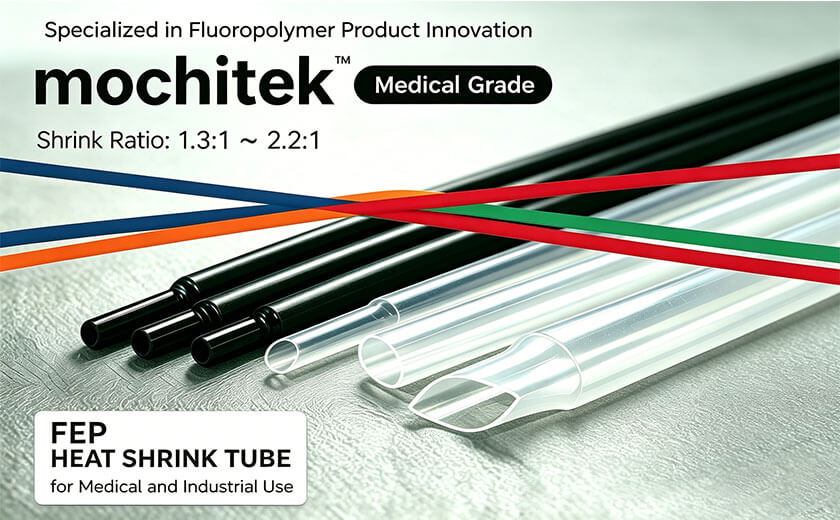
A8: Standard available shrink ratios: 1.3:1, 1.6:1, 1.8:1, 2:1. Most common stock‑keeping sizes cover these ratios. Custom shrink ratios can be technically evaluated upon request.
Q9: How are the insulation and flame‑retardant properties of FEP heat shrink tubing?
A9: MTK FEP‑HST heat shrink tubing features dielectric breakdown strength >30 kV/mm, volume resistivity >10¹⁸ Ω·cm, and VW‑1 flame rating. It suits high‑insulation and fire‑safety‑critical applications such as special cables, rail transit and electric motors.
Q10: Are custom color and packaging available?
A10: Transparent is the standard color. Alternative colors can be customized. Non‑standard inner diameters, special cut lengths and custom packaging are subject to evaluation. Refer to the official MTK FEP‑HST datasheet for full dimensional specifications.