The evolution of cardiac stent technology represents one of the most significant advancements in modern medicine, offering life-saving solutions for millions suffering from coronary artery disease. Among the various materials used, expanded polytetrafluoroethylene (ePTFE) has carved out a critical, niche role. While not a first-line treatment for standard blockages, ePTFE-covered stents are indispensable tools for managing complex and high-risk cardiac scenarios.
What is ePTFE?
Expanded Polytetrafluoroethylene (ePTFE) is a highly versatile synthetic fluoropolymer with a unique microstructure. It is created by stretching PTFE (best known by the brand name Teflon®) under specific conditions, creating a strong, porous, and biocompatible material. This expansion process forms a matrix of microscopic nodes interconnected by fine fibrils, resulting in a membrane that is:
-
Strong and flexible: It can withstand arterial pressures and conform to vessel anatomy.
-
Biocompatible: It is exceptionally inert, minimizing inflammatory responses and rejection by the body.
-
Impermeable: When used in stents, it is engineered to be a continuous, non-porous barrier to blood and tissue.
The Cardiac Stent: A Brief Overview
A stent is a small, mesh-like tube scaffold used to prop open a narrowed or weakened artery. The most common types are:
-
Bare-Metal Stents (BMS): Provide mechanical support.
-
Drug-Eluting Stents (DES): Coated with medication that slowly releases to prevent scar tissue growth (restenosis).
Most stents are metallic mesh, which is excellent for scaffolding but is inherently permeable.
The Unique Niche for ePTFE-Covered Stents
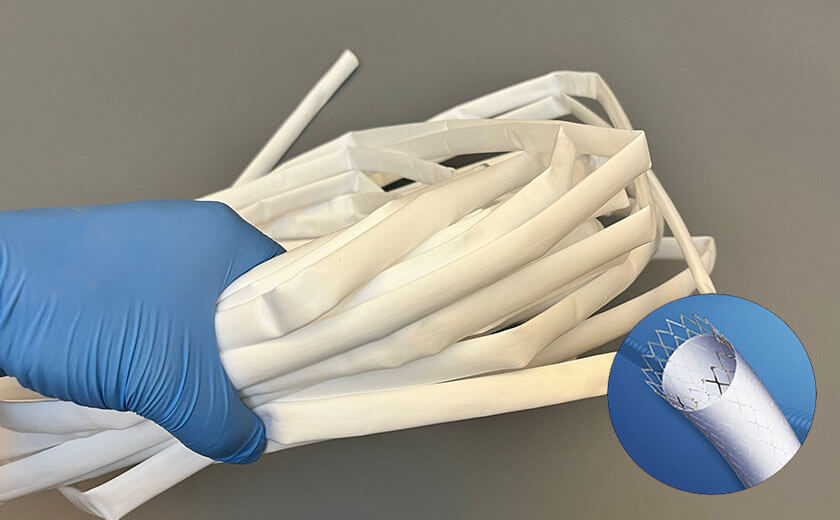
ePTFE-covered stents, often called “stent-grafts,” combine a traditional metal stent structure with an ePTFE membrane coating. This design addresses specific challenges that conventional stents cannot:
1. Management of Coronary Artery Aneurysms and Perforations:
This is the primary indication. A coronary aneurysm is a dangerous ballooning of the artery wall, while a perforation is a tear caused during a procedure. An ePTFE-covered stent acts as a sealed internal liner, excluding the aneurysm from blood flow or sealing the perforation to prevent life-threatening bleeding, effectively creating a new, intact vessel lumen.
2. Treatment of Vessel Rupture:
In rare cases, an artery can rupture during angioplasty or stent placement. An ePTFE-covered stent can be deployed emergently to seal the rupture and stabilize the patient, often avoiding the need for emergency open-heart surgery.
3. Preventing Distal Embolization in Saphenous Vein Grafts:
Bypass grafts made from leg veins (saphenous vein grafts) are often filled with fragile, atherosclerotic plaque. Intervening on these grafts with standard stents can dislodge debris, causing heart attacks. The ePTFE membrane acts as a filter, trapping this debris against the vessel wall and preventing it from flowing downstream.
Advantages of ePTFE-Covered Stents
-
Excellent Sealant: Provides an immediate physical barrier against blood leakage.
-
Exclusion Property: Ideal for isolating aneurysmal segments and perforations.
-
Proven Biocompatibility: Long history of safe use in vascular surgery (e.g., in synthetic grafts for peripheral arteries).
-
Mechanical Strength: The stent platform provides radial strength, while the ePTFE provides containment.
Limitations and Challenges
-
Higher Risk of Restenosis and Thrombosis: The ePTFE membrane can hinder the natural healing process of the vessel wall (endothelialization) and has a higher risk of clot formation (thrombosis) compared to Drug-Eluting Stents. This often necessitates longer duration of dual antiplatelet therapy (DAPT).
-
Less Flexibility: They are typically less flexible than modern DES, making them more challenging to deliver through tortuous anatomy.
-
Side Branch Occlusion: Once deployed, the membrane covers all side branches (smaller arteries originating from the main vessel), which can be a significant drawback in certain anatomical locations.
-
Niche Application: They are not used for routine blockages due to the above limitations and are reserved for specific complications.
The Future: Innovations and Developments
Research is focused on improving the design and performance of covered stents:
-
Drug-Eluting ePTFE: Incorporating antiproliferative drugs (like those on DES) onto the ePTFE membrane to reduce the risk of restenosis and thrombosis.
-
Improved Deliverability: Developing lower-profile, more flexible systems for easier navigation.
-
Bioabsorbable Coverings: Investigating temporary coverings that seal a perforation or aneurysm and are then absorbed, leaving behind a healed vessel.
Conclusion
ePTFE-covered stents are a vital specialist tool in the interventional cardiologist’s arsenal. They exemplify the principle of the right device for the right lesion. While standard drug-eluting stents remain the workhorse for everyday coronary disease, ePTFE-covered stents provide an elegant and life-saving solution for managing catastrophic complications like perforations and challenging conditions like aneurysms. Their continued development ensures that cardiologists are well-equipped to handle the most complex and dangerous scenarios within the coronary arteries.