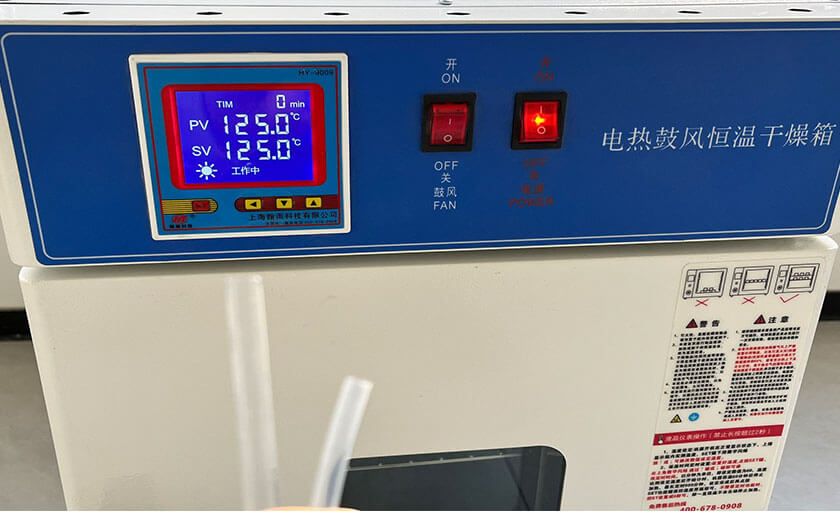
We often get a question from engineers with precise process requirements: “Your FEP tubing has a very high melt point, but we need it to fully shrink at 125°C. Can it do that without compromise?”
The answer is a definitive yes. In fact, the ability to shrink at a controlled, relatively low temperature—while retaining its extreme end-use properties—is one of the key engineered features of our FEP heat shrink, not a limitation.
Here’s a straightforward look at how it works and why it’s reliable.
It’s Not About Melting, It’s About Releasing Stored Energy
A common point of confusion is equating shrinkage temperature with melting temperature. For our FEP tubing, that’s not the case.
Think of the tubing in its supplied state as being gently stretched and then “frozen” in that position. The material inherently wants to return to its original, smaller diameter. The heat you apply isn’t melting it; it’s simply providing the energy needed to unlock that “memory.”
This “memory” is built in during manufacturing through a carefully controlled process of expansion. We heat the base tube just enough to make it pliable, expand it to its larger supplied size, and then rapidly cool it. At 125°C, you’re reheating it to that same pliable state, allowing the stored elastic energy to do the work and shrink it back down. This temperature is more than sufficient to activate this recovery.
Why 125°C is a Practical and Effective Target
Your specification for 125°C isn’t arbitrary; it’s a smart process parameter. Here’s why our material aligns perfectly with it:
1.Protects Sensitive Components: It allows you to create a permanent, high-performance seal or insulation around wires, sensors, or assemblies without subjecting them to excessive heat during installation. You get the benefit of FEP’s 200°C continuous use rating without the high-stress installation.
2.Ensures Predictable and Uniform Shrinkage: At 125°C, the shrinkage is controlled and complete. There’s no need to ramp temperatures higher to “force” it to fit, which can lead to uneven stresses or damage.
3.Process Efficiency: Lower temperature requirements often translate to faster cycle times and lower energy consumption in production settings. It’s a more practical and user-friendly processing window.
The Real Advantage: Performance After the Shrink
The critical point is what happens after the 125°C installation. This is where our FEP tubing truly stands apart. Once recovered, it provides:
- Long-term stability at temperatures far exceeding the installation heat.
- Nearly universal chemical resistance.
- Exceptional dielectric properties and low friction.
In other words, you use a practical, manageable amount of heat to install it, and it then performs as a permanent, inert, and high-temp barrier.
Conclusion: Engineered for Your Process, Built for Your Application
Our FEP heat shrink tubing is formulated and processed specifically to achieve a complete, tight recovery at industry-standard low-to-mid shrinkage temperatures like 125°C. This isn’t a coincidence; it’s by design to fit into real-world assembly processes.
When you specify 125°C, you’re specifying a need for precision, component safety, and process reliability. Our material is tested and proven to meet that need head-on, delivering not just a shrink at the right temperature, but the lasting performance you expect from fluoropolymer.
Have a specific application in mind with tight temperature parameters? Let’s discuss how our FEP tubing can meet your exact processing and performance requirements. Our contact information is as follows:
Phone: +86 15956561251
Email: ruby@mochi.org.cn
Looking forward to working with you to create a bright future!