As a company specializing in the manufacture of medical-grade heat shrink tubing, we have continuously optimized our products over the years to meet the unique needs of microcatheter manufacturers. We deeply understand that every component is crucial when manufacturing devices used to navigate the smallest blood vessels in the human body—there is no room for compromise in terms of precision, biocompatibility, and durability. This is why our 2:1 shrink ratio small diameter medical FEP heat shrink tubing has become the preferred choice for microcatheter teams around the world. Today, we will share why this heat shrink tubing is specifically designed for microcatheters and how it solves the most troublesome pain points we have heard from our customers.
We do more than just produce heat shrink tubing—our designs always focus on the needs of medical device manufacturers. Microcatheters have unique application scenarios: the heat shrink tubing they require must be ultra-small, sterile, flexible enough to withstand continuous bending, and at the same time strong enough to protect internal components. Over the years, we have worked closely with microcatheter engineers to solve their biggest headaches—heat shrink tubing that is too bulky, difficult to sterilize, or inconsistent in size. Our 2:1 shrink ratio small diameter medical FEP heat shrink tubing is the result of this collaboration.
We reject “one-size-fits-all” universal designs. This heat shrink tubing is completely tailored to the needs of microcatheter manufacturing, developed by a professional team familiar with the pain points of the microcatheter industry. Next, we will detail its core advantages based on production practice and actual customer feedback.
1.Medical-Grade FEP: Safety Always Comes First
For us, biocompatibility is not an add-on—it is the foundation of all our products. Our FEP heat shrink tubing contains no harmful additives or contaminants, strictly adheres to the core requirements of medical-grade materials, ensures it can meet the strict standards of microcatheter manufacturing, and provides reliable component support for customers’ subsequent production.
Our this heat shrink tubing is not a final medical product, but only used as a component for microcatheter manufacturing. Our FEP material has excellent physiological inertness, which means that even with long-term use, it will not decompose, nor will it react with blood, drugs, or body fluids, and can meet the usage requirements of microcatheter components.
We also attach great importance to traceability. Each batch of heat shrink tubing is accompanied by complete documentation, allowing customers to easily track production details—this has become increasingly important in medical device manufacturing. We use SAP production systems to ensure product consistency, and our quality control team conducts defect inspections on each roll of heat shrink tubing before it leaves the factory.
2.2:1 Shrink Ratio: Specifically Designed for Microscale Precision
We often hear from microcatheter engineers about the trouble of finding heat shrink tubing suitable for their tiny components. This is why we specially designed a 2:1 shrink ratio for this product. This ratio is the golden ratio for microcatheter applications—it allows customers to use a slightly larger expanded diameter during installation for easy operation, and then shrink it to half its original diameter to achieve a tight fit.
Our customers used to struggle with lower shrink ratios (1.3:1, 1.6:1). Such heat shrink tubing requires the use of extremely small expanded diameters, which makes it easy to damage when sliding the heat shrink tubing over precision guidewires or electrical leads. Our 2:1 shrink ratio heat shrink tubing is faster and easier to install, and reduces waste caused by component damage. When the heat shrink tubing is heated to 200-210°C (the standard heating temperature for FEP materials), it shrinks uniformly, closely fitting every contour of the internal components of the microcatheter without gaps or looseness.
Flexibility is also crucial. When designing this heat shrink tubing, we balanced strength and flexibility—ensuring that it does not affect the microcatheter’s ability to navigate curved blood vessels. Our customers have reported that this balance has reduced rework rates and improved the overall performance of the devices.
3.Small Diameter Design: Adapting to the Size Constraints of Microcatheters
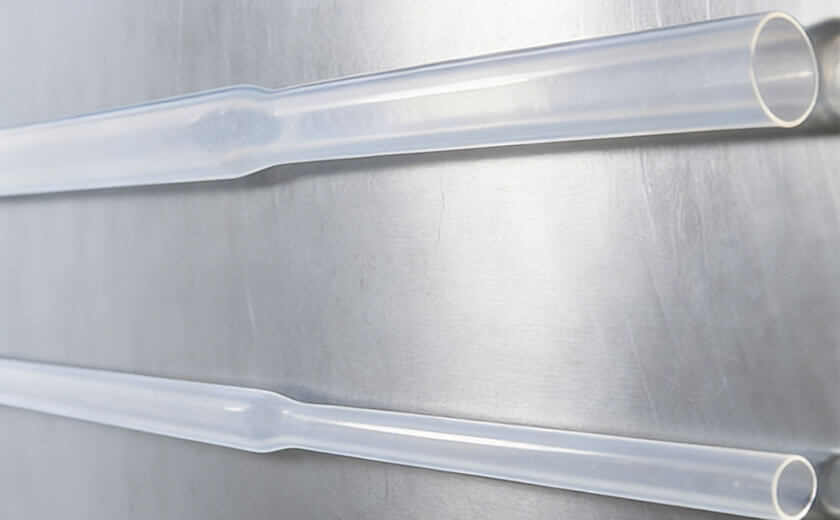
Microcatheters require extremely small heat shrink tubing—with a diameter as small as 0.5 mm (0.02 inches) after shrinkage. Standard heat shrink tubing often sacrifices quality when reaching this size, so we specially designed this product for microscale applications. The expanded inner diameter of our heat shrink tubing ranges from 0.8 mm to 9.0 mm, and the inner diameter after shrinkage can be as small as 0.5 mm—perfectly adapting to the most compact microcatheter designs.
Consistency is crucial in the manufacturing process. We use online laser diameter measurement technology to ensure that the size of each section of heat shrink tubing remains consistent from end to end. There are no dimensional deviations, no “accidents” that waste time and materials. Our Process Capability Index (CPK) > 1.33 ensures stable production, allowing customers to obtain consistent fit and performance for each batch of products.
4.Transparency and Durability: Details Determine Quality
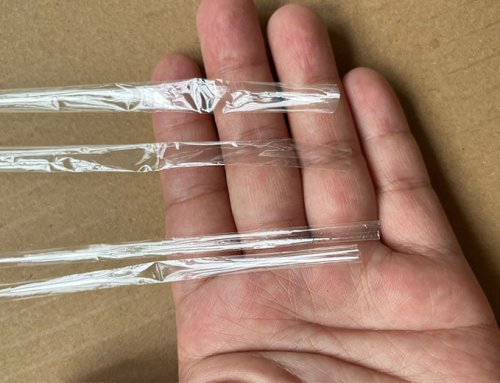
Transparency is one of the most frequently requested features by our microcatheter customers—and we have achieved it. Our FEP heat shrink tubing remains crystal clear even after shrinkage, allowing engineers to visually inspect internal components after installation. There is no need for additional tests to check for component alignment or air bubbles—you can see it at a glance. This saves quality control time and reduces the risk of defective devices.
Durability is another core consideration for us. This heat shrink tubing can withstand a temperature range of -70°C to 200°C, and can adapt to the production and subsequent clinical use environment of microcatheters. It is resistant to alcohols, disinfectants, and body fluids—we have never received feedback from customers about its degradation. In addition, it has an extremely low friction coefficient (second only to PTFE), which can reduce wear on microcatheter components, and at the same time has high tensile strength (minimum 2000 psi) and dielectric strength (minimum 500 V/mil), ensuring reliable insulation performance.
Customer Feedback
We don’t just talk the talk—our customers’ actual usage results speak louder. One microcatheter manufacturer told us that after switching to our heat shrink tubing, their scrap rate dropped by 15% and the production time per device was reduced by 10%. Another customer said that thanks to the stability and traceability of our products, they had no production or usage issues related to heat shrink tubing. Most importantly, their clinical partners reported that the flexibility and reliability of the microcatheters have been significantly improved.
We also offer customization services—because every microcatheter design is unique. Our team works closely with customers to customize wall thickness, expanded/shrunk diameter, and even special formulas according to their specific needs. Off-the-shelf heat shrink tubing often cannot meet the special needs of microcatheters, and we are proud to provide solutions that fully meet customers’ design requirements.
Who Is This Heat Shrink Tubing For?
If you are manufacturing microcatheters—whether diagnostic, drug delivery, or interventional—this heat shrink tubing is tailored for you. It is also suitable for other small medical devices that require biocompatibility, precision, and durability: guidewires, small surgical instruments, and micro-scale drug delivery systems.
When choosing a heat shrink tubing manufacturer, you should choose a partner who understands your industry. We do more than just produce heat shrink tubing—we work with customers to solve problems. From complete traceability to customized solutions, we support your production process every step of the way.
Conclusion
As a manufacturer, we deeply understand the importance of suitable components for medical device production. Our 2:1 shrink ratio small diameter medical FEP heat shrink tubing is specifically designed for microcatheters—because we understand the unique challenges you face.
We are not just selling products—we are providing a solution that saves you time, reduces waste, and helps you manufacture safer and more reliable microcatheters. If you are tired of using heat shrink tubing with poor fit and low quality, welcome to try our 2:1 shrink ratio small diameter medical FEP heat shrink tubing. Our team is always ready to answer your questions and help you find the most suitable product for your design.
If you have any questions about how this heat shrink tubing can be applied to your microcatheter production, please leave a comment below or contact our team directly—we are happy to help you.